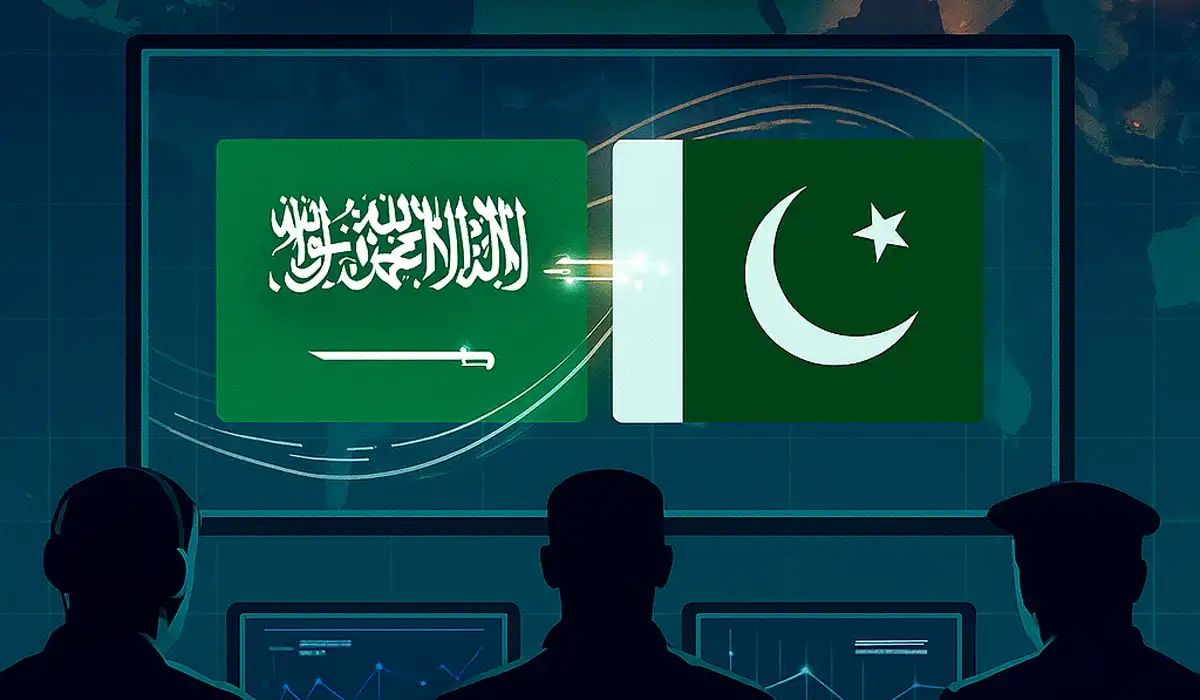
The recently signed Strategic Mutual Defence Agreement (SMDA) between Saudi Arabia and Pakistan has triggered intense debate across global capitals. While hailed in Islamabad and Riyadh as a “historic milestone,” the pact has raised red flags in Washington, New Delhi, and Tel Aviv. The agreement, which declares that “any aggression against either country shall be considered an aggression against both”, is being interpreted as a potential game-changer in the geopolitics of South Asia and the Middle East.
What the Saudi-Pakistan Pact Means
- Mutual Defence Clause: The pact resembles a NATO-style commitment, binding both nations to respond jointly to external aggression.
- Historical Context: Saudi-Pakistan defence ties date back to the 1960s, when Pakistani troops were stationed in the Kingdom. The relationship deepened after the 1979 Iranian Revolution, with Pakistan pledging to safeguard the holy cities of Mecca and Medina.
- Strategic Timing: The deal comes amid heightened tensions—Israel’s strikes in Gaza and Doha, India-Pakistan clashes earlier this year, and Gulf states’ growing doubts about U.S. security guarantees.
Why the U.S. Is Concerned
- Erosion of U.S. Influence: Washington has long been Riyadh’s primary security guarantor. The pact signals Saudi Arabia’s willingness to diversify its defense partnerships, potentially reducing its reliance on the U.S.
- Nuclear Angle: Former U.S. diplomat Zalmay Khalilzad raised alarms over speculation that Saudi Arabia may have indirectly supported Pakistan’s nuclear program. If true, the pact could deepen nuclear proliferation risks in the region.
- China Factor: With 81% of Pakistan’s arms imports coming from China, the U.S. sees the alliance as indirectly strengthening Beijing’s influence in the Gulf.
Why Israel Is Alarmed
- New Deterrent Dynamics: For the first time, Israel must consider that its military actions in the region could trigger a response not just from Iran, but also from a Sunni-majority nuclear-armed Pakistan.
- Regional Fallout: Israel’s recent strikes on Qatar and Gaza have already strained its relations with Arab states. The Saudi-Pakistan pact could embolden calls for an “Islamic NATO” that positions itself against Israeli military actions.
- Strategic Uncertainty: Analysts warn that Israel now faces a more complex deterrence environment, where its traditional military superiority may be challenged by new coalitions.
Why India Is Watching Closely
- Direct Security Implications: India and Pakistan remain bitter rivals, with recent skirmishes escalating dangerously. A Saudi-backed Pakistan could embolden Islamabad in future conflicts.
- Diplomatic Balancing Act: India and Saudi Arabia share strong economic ties—bilateral trade exceeded USD 41 billion in FY 2024-25, compared to just USD 3–4 billion between Riyadh and Islamabad. Saudi officials have reassured New Delhi that the pact is “not aimed at India,” but Indian policymakers remain cautious.
- Islamic NATO Concerns: Pakistan’s push for a broader Arab-Islamic military alliance raises fears in New Delhi that Kashmir could be internationalized under the banner of Muslim solidarity.
Expert Opinions
- “A Watershed Moment”: Security analysts describe the pact as a turning point, formalizing decades of informal cooperation and reshaping the Gulf’s security architecture.
- “Posturing or Reality?”: Some experts argue that while the pact looks formidable on paper, Saudi Arabia is unlikely to risk its deep economic ties with India or its delicate relationship with the U.S..
- “Declining U.S. Credibility”: The deal underscores Gulf states’ doubts about Washington’s reliability, especially after its muted response to Israel’s strike on Doha.
Conclusion
The Saudi-Pakistan defence pact is more than a bilateral agreement—it is a signal of shifting power balances across Asia and the Middle East. For the United States, it challenges decades of strategic dominance. For Israel, it complicates deterrence calculations. For India, it raises the specter of a stronger, Saudi-backed Pakistan.
As the geopolitical chessboard evolves, one thing is clear: this alliance will be watched closely, not just in Riyadh and Islamabad, but in Washington, New Delhi, and Tel Aviv.