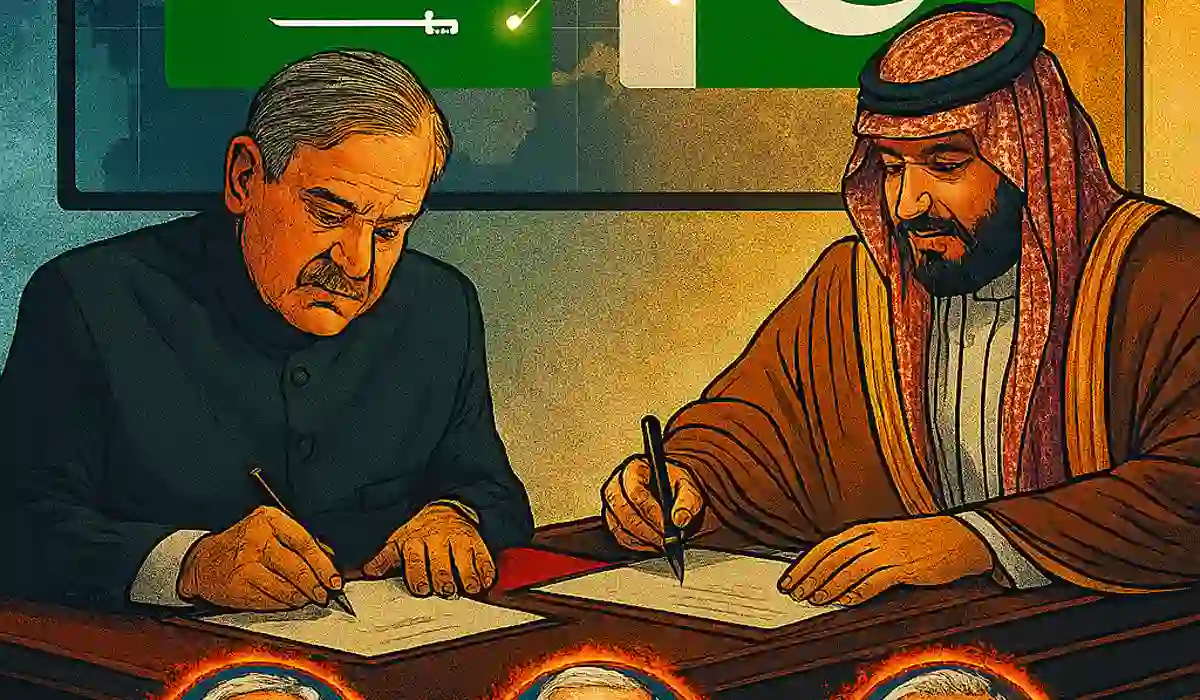
On September 17, 2025, Pakistan and Saudi Arabia signed a landmark Strategic Mutual Defence Agreement, a move that formalizes their decades-long security partnership and pledges mutual defense against external aggression. Signed in Riyadh during Pakistani Prime Minister Shehbaz Sharif’s visit, the pact declares that an attack on either nation will be treated as an attack on both. Amid rising regional tensions, particularly following Israel’s September 9 airstrike on Doha, this agreement has raised concerns among global powers, including the United States, Israel, and India. This article examines the pact’s context, its implications, and the reactions of key stakeholders.
Context of the Strategic Defence Agreement
The Saudi-Pakistan partnership is rooted in shared religious, economic, and military ties. Since the 1960s, Pakistan has trained over 8,200 Saudi military personnel, conducted joint exercises, and maintained a military presence in the kingdom, with an estimated 1,500–2,000 troops currently deployed. Saudi Arabia, a key financial supporter, extended a $3 billion loan to Pakistan in December 2024 to stabilize its economy. The new pact builds on a 1982 agreement, institutionalizing deeper defense cooperation.
The agreement’s timing is significant. It follows Israel’s airstrike on Qatar’s capital, Doha, targeting Hamas leaders during ceasefire talks, which killed six people, including a Qatari security officer. The attack, reportedly approved by the U.S. Trump administration, sparked outrage across Arab and Islamic nations, prompting an emergency summit of the Arab League and Organisation of Islamic Cooperation (OIC) on September 15. Gulf states, increasingly wary of U.S. reliability as a security guarantor, are seeking alternative alliances, with the Saudi-Pakistan pact emerging as a strategic response.
Key Features of the Defence Pact
The Strategic Mutual Defence Agreement, signed by Saudi Crown Prince Mohammed bin Salman and Prime Minister Shehbaz Sharif, emphasizes joint deterrence and defense cooperation. A key clause states: “Any aggression against either country shall be considered an aggression against both.” While the agreement does not explicitly reference nuclear capabilities, speculation about Pakistan extending a “nuclear umbrella” to Saudi Arabia has surfaced, given Pakistan’s status as the Muslim world’s only nuclear power. A senior Saudi official, speaking to Reuters, described the pact as a “comprehensive defensive agreement encompassing all military means” but clarified it was not aimed at specific countries.
The pact strengthens existing cooperation, including military training, joint exercises, and potential arms procurement. For Pakistan, it secures vital Saudi investment and elevates its role as a regional security provider. For Saudi Arabia, it bolsters defenses against threats from Iran, Houthi rebels in Yemen, and regional instability fueled by Israel’s actions.
Implications for the United States
The pact underscores growing Gulf skepticism about U.S. security commitments. Despite hosting 40,000–50,000 U.S. troops across the region, including at Qatar’s Al-Udeid base and Saudi Arabia’s Prince Sultan Air Base, Gulf states are concerned about Washington’s perceived acquiescence to Israel’s regional strikes. The Doha attack, described by Qatar as “state terrorism,” highlighted U.S. hesitance to restrain Israel, pushing Saudi Arabia to seek alternative security partners.
The U.S. has not officially responded to the pact, but analysts suggest it could strain U.S.-Saudi relations. Ted Singer, a former CIA Middle East operations head, told Middle East Eye that the agreement signals a broader Gulf shift toward “independence from a broken security order.” Washington may need to reassess its Middle East strategy, particularly as Gulf states explore collective security frameworks like a proposed Arab-Islamic NATO.
Implications for Israel
Israel, widely believed to possess a nuclear arsenal despite its policy of ambiguity, faces new strategic challenges. The Saudi-Pakistan pact, signed days after the Doha strike, appears partly as a signal to Israel, which has been engaged in multifront conflicts across Gaza, Lebanon, Syria, Iran, and Yemen since Hamas’s October 2023 attack. The mutual defense clause could deter Israeli actions against Pakistan or its allies, complicating Israel’s regional strategy.
Speculation about Saudi Arabia accessing Pakistan’s nuclear capabilities remains unconfirmed. Experts like Husain Haqqani, former Pakistani ambassador to the U.S., argue that Pakistan’s conventional forces are sufficient for Saudi Arabia’s needs, reducing the likelihood of nuclear escalation. Nonetheless, the pact adds a layer of complexity to Israel’s security calculations, particularly as it navigates tensions with Iran and other regional actors.
Implications for India
India, a key Saudi partner in trade, energy, and defense, is closely monitoring the pact. The agreement comes months after a brief but intense India-Pakistan conflict in May 2025, triggered by Operation Sindoor, a retaliatory Indian strike following a terrorist attack in Jammu and Kashmir linked to Pakistan. The mutual defense clause raises concerns about Saudi Arabia’s stance in a potential future India-Pakistan conflict, given Pakistan’s nuclear capabilities and historical rivalry with India.
India’s Ministry of External Affairs, through spokesperson Randhir Jaiswal, issued a measured response: “We have seen reports of the signing of a strategic mutual defence pact between Saudi Arabia and Pakistan. The government was aware that this development, which formalizes a long-standing arrangement, had been under consideration. We will study its implications for our national security and regional stability.” Indian analysts, including those cited by The Economic Times, warn that the pact could embolden Pakistan, though Saudi officials have emphasized that their relationship with India remains “more robust than ever.”
India’s strategic partnership with Saudi Arabia, strengthened through agreements like the 2006 Delhi Declaration, 2010 Riyadh Declaration, and the April 2025 Strategic Partnership Council, includes $100 billion in Saudi investments and joint ventures like the $44 billion West Coast Refinery Project. The pact’s impact on initiatives like the India-Middle East-Europe Economic Corridor remains uncertain, prompting India to recalibrate its diplomacy to maintain strong ties with Riyadh.
Regional and Global Impact
The Saudi-Pakistan pact is a pivotal development in West and South Asian geopolitics. It reflects a broader realignment as Gulf states hedge against U.S. retrenchment and regional volatility. The agreement could deter aggression from Iran or Israel but risks escalating tensions if misinterpreted. It also aligns with discussions at the Doha summit about a collective Arab-Islamic security framework, potentially reshaping the Middle East’s security architecture.
For India, the pact underscores the need to balance its growing ties with Saudi Arabia against the risks posed by Pakistan’s strengthened position. For the U.S. and Israel, it highlights the urgency of addressing Gulf concerns to maintain influence in the region. China, a close Pakistani ally, may also benefit indirectly, as the pact validates its multipolar world strategy, though Beijing has urged restraint to avoid oil disruptions.
Conclusion
The Saudi-Pakistan Strategic Mutual Defence Agreement marks a turning point in regional security dynamics, driven by shared concerns over instability and declining U.S. influence. While it strengthens the historic Riyadh-Islamabad alliance, it raises questions for the U.S., Israel, and India, each navigating a complex web of alliances and rivalries. As global powers assess the pact’s implications, the agreement underscores the evolving nature of Middle Eastern and South Asian geopolitics, with far-reaching consequences for regional stability.