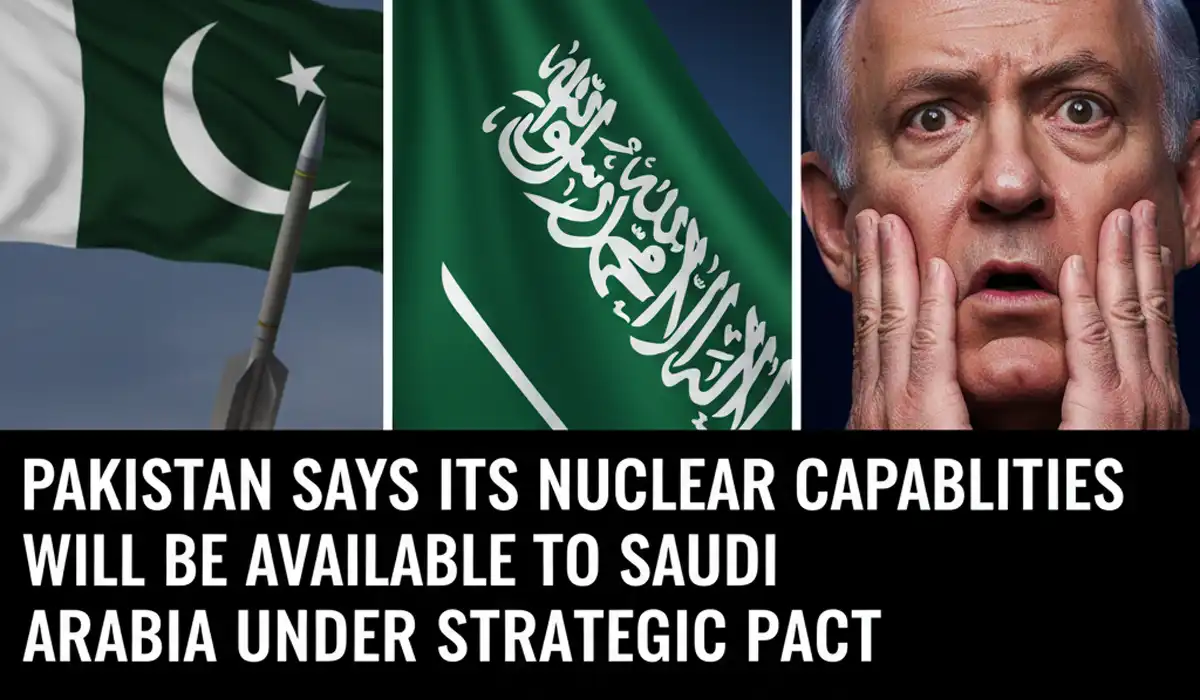
PAKISTAN SAYS ITS NUCLEAR CAPABILITIES WILL BE AVAILABLE TO SAUDI ARABIA UNDER STRATEGIC PACT
Islamabad / Riyadh — Pakistan’s Defence Minister, Khawaja Mohammad Asif, has stated that Islamabad’s nuclear deterrent “will be made available” to Saudi Arabia under the new “Strategic Mutual Defense Agreement” signed earlier this week, marking a major shift in regional security dynamics.
Key Details of the Pact
- The agreement declares that any aggression against either Pakistan or Saudi Arabia will be considered aggression against both nations.
- Asif called the pact an “umbrella arrangement,” under which joint response to threats is pledged, though he emphasized that it is defensive in nature.
- In an interview with Geo TV, the Defence Minister clarified that Pakistan’s capabilities—including its nuclear program—“will absolutely be available under this pact.”
Contradictions and Clarifications
- Later, Asif told Reuters that nuclear weapons themselves are “not on the radar” of the agreement, implying that while deterrence is shared, explicit deployment or transfer of weapons is not confirmed.
- Pakistan’s Foreign Office has avoided detailed comment on how this pact interacts with its long-standing doctrine, which has historically been targeted primarily at threats from India.
Reactions and Implications
- Analysts view this move as a signal toward strengthening Saudi-Pakistan strategic ties at a time of regional uncertainty, especially with rising concern among Gulf states about Israel’s actions and the stability of existing defense guarantees.
- The inclusion of nuclear deterrence (even if ambiguously defined) shifts the security calculus in the Middle East, as Saudi Arabia becomes more visibly protected under Pakistan’s strategic posture.
What’s Not Yet Confirmed
- There is no public detail yet on the terms: such as whether Pakistani nuclear weapons would ever be stationed in Saudi Arabia, or whether Saudi forces would have operational control in any scenario.
- It is unclear what safeguards, oversight, or verification measures are included, especially in relation to international treaties like the IAEA (International Atomic Energy Agency).