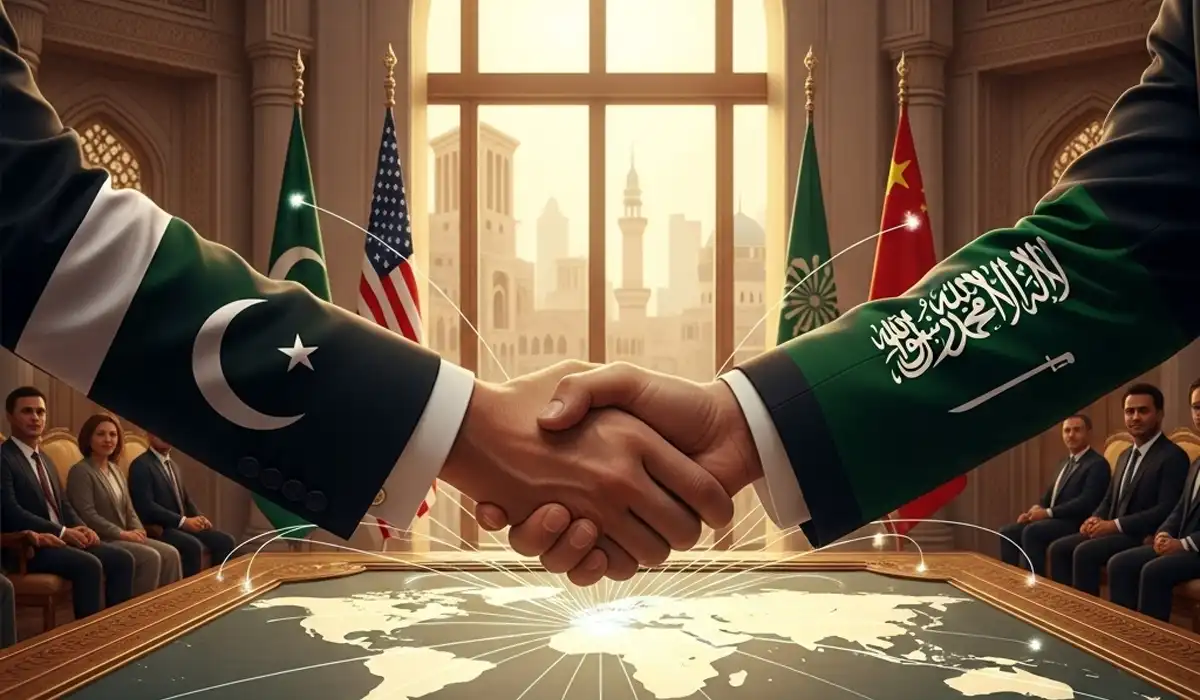
Riyadh/Islamabad (September 18, 2025) — In a landmark development, Pakistan and Saudi Arabia have signed a Strategic Mutual Defence Agreement aimed at boosting bilateral relations and reshaping the balance of power across South Asia and the Middle East.
The deal, signed at Riyadh’s Al-Yamamah Palace during Prime Minister Shehbaz Sharif’s visit, formalizes a long-discussed partnership that could have significant geopolitical consequences for global powers including the United States, India, and Israel.
Key Features of the Defence Pact
- Mutual Defence Clause
Both countries agreed that an attack on one will be treated as an attack on both, reinforcing collective security. - Military and Intelligence Cooperation
The pact includes provisions for joint training, intelligence sharing, and closer military coordination. - Commitment to Peace
Officials from both sides emphasized that the agreement is not aggressive but designed to strengthen regional stability and safeguard the Islamic world.
Why This Pact Matters
Pakistan and Saudi Arabia already share decades of close political, military, and economic relations. However, this formalized defence agreement is viewed as a strategic shift in regional alliances.
- For Pakistan, it elevates its international standing, aligning it more firmly with a key Gulf power.
- For Saudi Arabia, it diversifies its security partnerships beyond traditional reliance on the United States, signaling a broader shift in its defence strategy.
Impact on Global Powers
United States
The US has historically been Saudi Arabia’s primary security guarantor. This agreement may signal to Washington that Riyadh is seeking greater independence in defence matters, potentially complicating US influence in the Gulf.
India
India, which maintains strong trade and energy ties with Saudi Arabia, is watching the development closely. Analysts believe the pact could indirectly strengthen Pakistan’s regional position, particularly given the two countries’ longstanding tensions.
Israel
Prospects for Saudi-Israel normalization, which had been under discussion in recent years, may face fresh challenges. Pakistan has no diplomatic relations with Israel, and Riyadh’s deepened military alignment with Islamabad could make normalization politically difficult.
Expert Reactions
Regional analysts suggest that while the pact has strong symbolic value, its real impact will depend on how far both nations go in implementing military cooperation. Some argue that the ambiguity surrounding nuclear deterrence adds a layer of strategic uncertainty, which could reshape defence calculations across the Middle East.
Looking Ahead
Both Islamabad and Riyadh have presented the agreement as a step toward greater regional peace and security, not confrontation. Still, the pact is likely to influence future strategies of major powers, as Saudi Arabia and Pakistan now project a united front in matters of defence.